It’s been 21 months since my husband passed, and still… I say we, and our. Not just in memories — but in the present tense. Our room. Our house. Our friend. We’ve lost a friend.
Every time it happens, I feel that tiny internal jolt: should I be saying I now? Should I be more “realistic”? Should I be further along in whatever people imagine grief is supposed to look like?
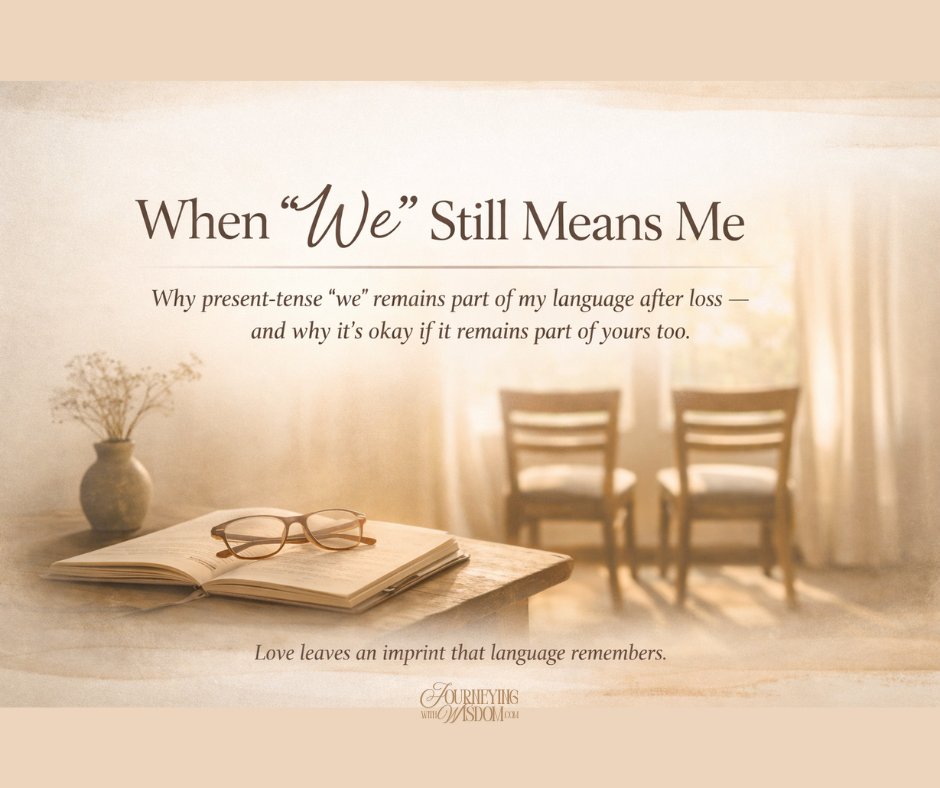
But here’s the truth I’ve learned quietly, slowly, and honestly: My life didn’t stop being shaped by “we” just because death changed the physical reality. The present tense still carries the imprint of the life we built together. My preferences, my routines, my reactions — they were formed in partnership. So when I say we, I’m not speaking as two people. I’m speaking as the person I became through us.
And maybe you’ve felt it too. That hesitation before you speak. That worry that people might pity you, or think you’re not moving on, or assume you’re clinging to something you should have let go.
But present‑tense “we” isn’t clinging. It’s not denial. It’s not a refusal to accept reality.
It’s the language of a heart that was shaped in companionship — and still carries that shape.
I’m writing this because I know I’m not the only one. There are others who still speak in the plural, even while living in the singular. Others who feel that tension between honesty and expectation. Others who wonder if they’re doing grief “wrong.”
If that’s you, I want you to know: You’re not strange. You’re not stuck. You’re not failing.
You’re human. And your language is simply telling the truth about the life you lived — and the love that still forms part of who you are.


Leave a comment